Thailand Travel Vaccines: What's Actually Recommended vs. Required
No vaccine is legally required to enter Thailand for most travelers — the one exception is proof of yellow fever vaccination, and that only applies if you're arriving from or have recently transited a country with yellow fever risk. Everything else you'll read about — hepatitis A, typhoid, Japanese encephalitis, rabies — is a recommendation based on how you're traveling and where, not a rule anyone checks at immigration.
That gap between "recommended" and "required" is where most of the confusion online comes from. Forums are full of travelers asking whether they "really" need a fistful of shots for a two-week beach trip, and the honest answer is almost always no — but the answer changes fast if you're staying a month, heading somewhere rural, or planning to spend time around animals. Here's what actually applies to which kind of trip.

The one real legal requirement: yellow fever, and only sometimes
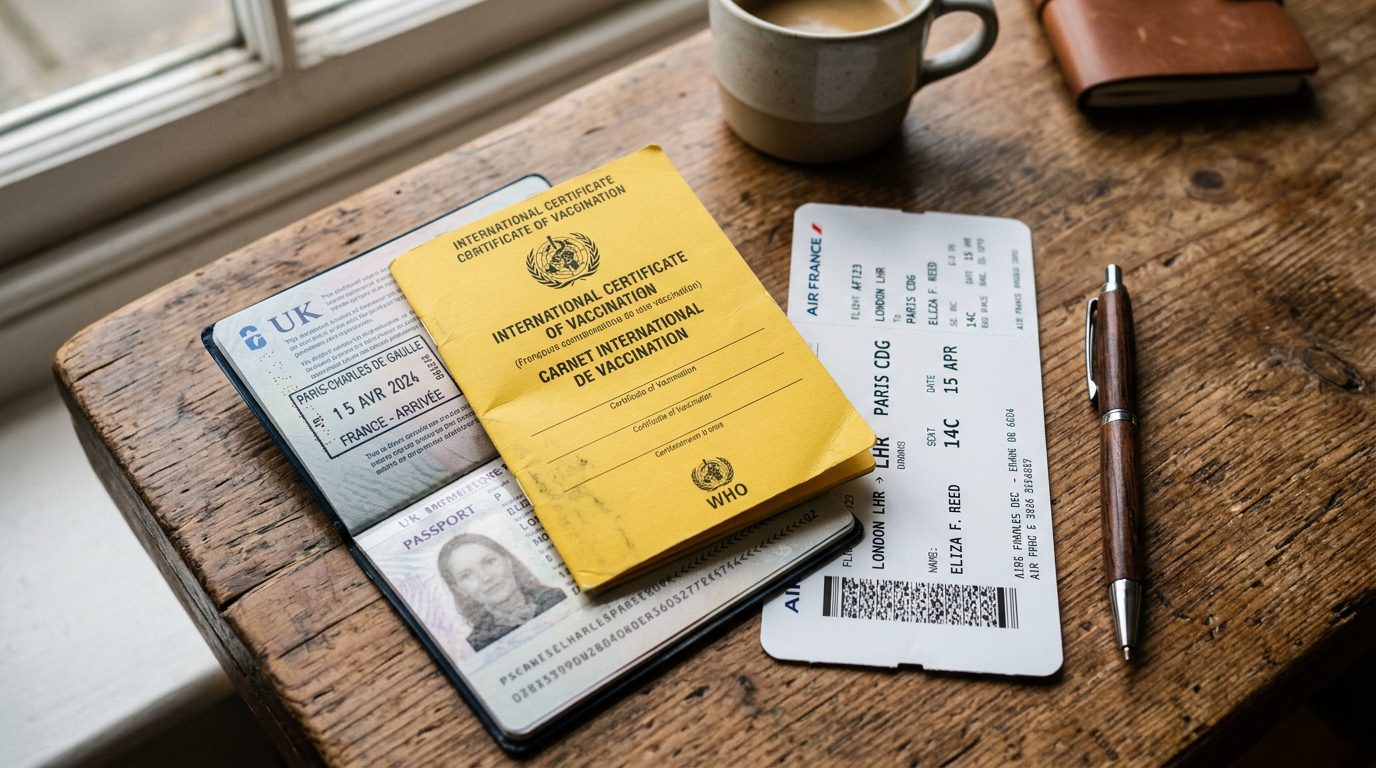
Thailand does not have a general vaccine requirement for entry. The single legal exception is the International Certificate of Vaccination (the "yellow card") for yellow fever, and it only applies if you are arriving from, or have transited for more than 12 hours through, a country with risk of yellow fever transmission — mostly parts of sub-Saharan Africa and South America. If you're flying in directly from the US, UK, Europe, Australia, or elsewhere in Asia, this simply doesn't apply to you.
If it does apply to your itinerary, get the vaccine at least 10 days before you travel — that's the point at which the certificate becomes valid, not the day you get the shot. A single dose is considered valid for life under current WHO rules, so if you've had it before for another trip, you likely don't need it again; just bring the card.
Routine vaccines you should already have current
Before worrying about anything Thailand-specific, the baseline the CDC recommends for literally any international destination still applies: make sure you're up to date on MMR (measles, mumps, rubella), Tdap (tetanus, diphtheria, pertussis), your annual flu shot if it's in season, and polio if you're due for a booster. None of these are Thailand-specific risks — they're just good practice for international travel generally, and it's easy to assume you're covered when your last booster was actually a decade ago.
The vaccines most travelers should seriously consider
These aren't required, but they show up on almost every legitimate travel-medicine recommendation for Thailand, and they're the ones worth a real conversation with a doctor or travel clinic before you go:
- Hepatitis A — spread through contaminated food and water, which describes a lot of street food and ice in Thailand. This is the most commonly recommended non-routine shot for the destination, for short trips and long ones alike.
- Typhoid — also food- and water-borne, and more relevant the more you're eating off the beaten path (markets, small local restaurants, rural areas) rather than sticking to hotel buffets and chain restaurants.
- Hepatitis B — relevant if there's a real chance you'll need medical or dental care in Thailand, get a tattoo or piercing, or otherwise have blood/bodily-fluid exposure. More of a consideration for longer stays than a one-week holiday.
None of these are dramatic risks for a standard tourist itinerary, but they're each low-cost, low-hassle, and cover a real (if modest) exposure most travelers actually have. This is the tier where "recommended" earns its place — unlike a lot of travel-health advice that's really just covering worst-case scenarios that don't apply to your trip.

Japanese encephalitis: who actually needs it
This is the vaccine that generates the most forum debate, and the real answer is genuinely conditional. The CDC's own guidance is that JE vaccination is recommended for travelers spending a month or more in JE-endemic areas during transmission season, and "should be considered" for shorter trips that involve real rural exposure — think farming areas, rice paddies, extended time outdoors in the evening, or accommodation without screens or air conditioning.
For a two-week trip through Bangkok, Chiang Mai's old city, and the islands, most travel-medicine sources put the actual risk low enough that it's not a standard recommendation. The calculus changes if your trip includes extended rural stays, trekking with overnight village homestays, or you're relocating for a longer stint of work or study, especially outside the main cities. If any of that describes your plans, it's worth raising with a travel clinic specifically — the vaccine is a two-dose series typically given about 28 days apart, so it needs lead time before departure.
Rabies: pre-exposure shots or not?
Thailand has a real stray-dog and free-roaming-monkey population, and rabies is almost always fatal once symptoms start — which is exactly why this question gets asked so often. The nuance that gets lost in the panic: pre-exposure vaccination doesn't prevent rabies on its own. If you're bitten or scratched, you still need post-exposure treatment either way. What the pre-exposure series changes is how urgent that treatment is and how straightforward it is to get — travelers who've had the pre-exposure shots need fewer follow-up doses and can skip the rabies immunoglobulin, which is sometimes in short supply outside major hospitals.
For most tourists sticking to Bangkok, Phuket, Chiang Mai, and other well-served areas, the practical guidance is that pre-exposure shots aren't strictly necessary — hospitals in these areas stock post-exposure treatment and can start it quickly if you're bitten. It becomes more worth considering if you're heading somewhere genuinely remote (islands or hill regions without quick hospital access), traveling with kids who may not report a scratch, or planning activities with real animal contact (long-term volunteering, wildlife work, extended trekking). Either way, treat any bite or scratch — even from a friendly-seeming temple dog or a monkey at a tourist site — as something to get looked at within 24 hours, not something to shrug off. A hospital visit for post-exposure treatment is exactly the kind of unplanned medical cost that travel insurance is meant to cover; see our guide to Thailand travel insurance for what's typically included.
What about malaria and dengue?
Two more topics that come up constantly and deserve a straight answer:
Malaria is not a concern in the areas most tourists actually visit — Bangkok, Chiang Mai, Phuket, Koh Samui, and the other main island and city destinations are considered malaria-free or negligible-risk by the CDC. Antimalarial medication becomes relevant mainly for travel to specific forested or border regions (parts of the area near Myanmar, Cambodia, and Laos), not a standard two-week holiday. If your itinerary includes those border areas specifically, that's a conversation for a travel clinic, not a blanket "take pills just in case."
Dengue doesn't have a vaccine that's broadly recommended for travelers from the US — the CDC doesn't recommend it as standard for most visitors, even though dengue itself is a real and rising concern across Southeast Asia, cities included. Prevention here is about mosquito-bite avoidance (repellent, covering up at dawn and dusk when Aedes mosquitoes are most active, and screened or air-conditioned rooms) rather than a shot, which is a different topic worth its own deeper look.
When and where to actually get these vaccines
If you're going the pre-departure route, give yourself lead time — some of these (JE, rabies pre-exposure, hepatitis B) are multi-dose series spread over several weeks, so a visit to a travel clinic 4 to 6 weeks before you fly gives everything time to take effect and, where relevant, to fit in a second or third dose.
If that timeline doesn't work, know that all of the vaccines discussed here are also readily available at travel clinics and hospitals inside Thailand itself — Bangkok and Chiang Mai in particular have well-regarded clinics used to tourists and long-term expats walking in without a referral, often at a lower cost than the same shots would run at a travel clinic back home. Plenty of long-stay travelers and digital nomads simply handle this after arrival rather than before. If you do end up needing care of any kind while you're there — vaccine-related or otherwise — our guide to hospitals, pharmacies, and getting sick in Thailand covers what to expect and what it actually costs.
▶Watch on VacaHack
Quick answers
Do I need a yellow fever vaccine for Thailand?
Only if you are arriving from, or have transited more than 12 hours through, a country with risk of yellow fever transmission (mainly parts of sub-Saharan Africa and South America). If you are flying in directly from the US, UK, Europe, Australia, or elsewhere in Asia, this does not apply to you, and it is the only vaccine Thailand legally requires proof of.
Is the Japanese encephalitis vaccine necessary for a two-week trip to Thailand?
Usually not for a standard city-and-island itinerary. The CDC recommends it mainly for travelers spending a month or more in endemic areas, or shorter trips with real rural exposure like farming areas, overnight village stays, or extended evening time outdoors without screens.
Do I need rabies shots before traveling to Thailand?
Most tourists sticking to Bangkok, Phuket, Chiang Mai, and other well-served areas do not strictly need pre-exposure shots, since hospitals in these areas stock post-exposure treatment. It is worth considering for remote travel, extended animal contact, or trips with young children. Either way, any bite or scratch should be checked within 24 hours.
Is there a vaccine for dengue fever in Thailand?
The CDC does not recommend a dengue vaccine as standard for most US travelers, even though dengue risk is real and rising across Southeast Asia. Prevention centers on mosquito-bite avoidance rather than vaccination.
Do I need malaria pills for Bangkok, Phuket, or Chiang Mai?
No. These and most other main tourist destinations in Thailand are considered malaria-free or negligible-risk. Antimalarial medication is mainly relevant for specific forested or border regions near Myanmar, Cambodia, and Laos.
Can I get travel vaccines in Thailand instead of before I leave?
Yes. Travel clinics and hospitals in Bangkok and Chiang Mai in particular are well-equipped and used to tourists and expats walking in without an appointment, often at a lower cost than the same shots at home. Many long-stay travelers handle this after arrival rather than before departure.