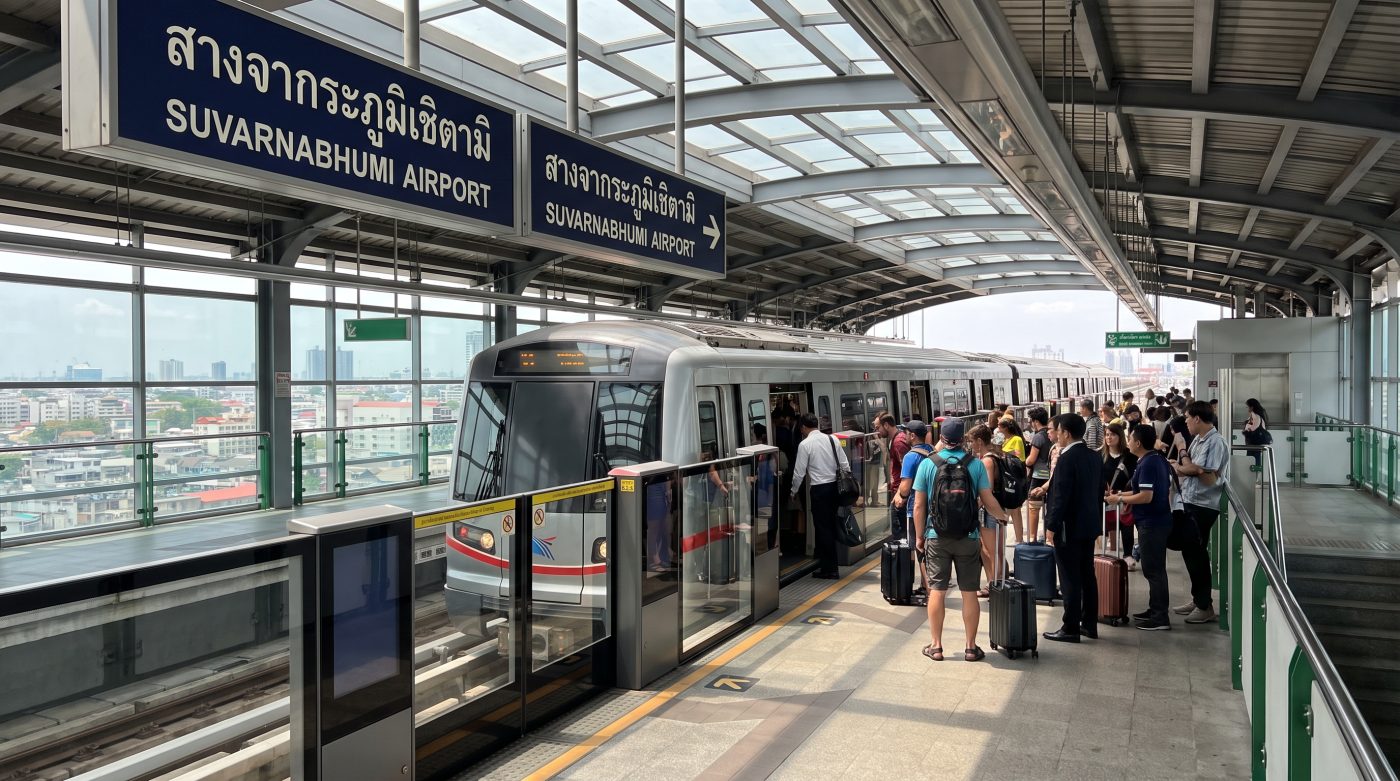
Domestic Flights in Thailand: Which Airline to Pick and What They Actually Cost
Thailand has six airlines flying its domestic routes, and which one you book changes more than just the price — it decides which Bangkok airport you leave from, whether checked baggage costs extra, and your odds of sitting on the tarmac for an hour. Here's what each one actually costs, what they don't advertise upfront, and what your rights are if things go wrong.
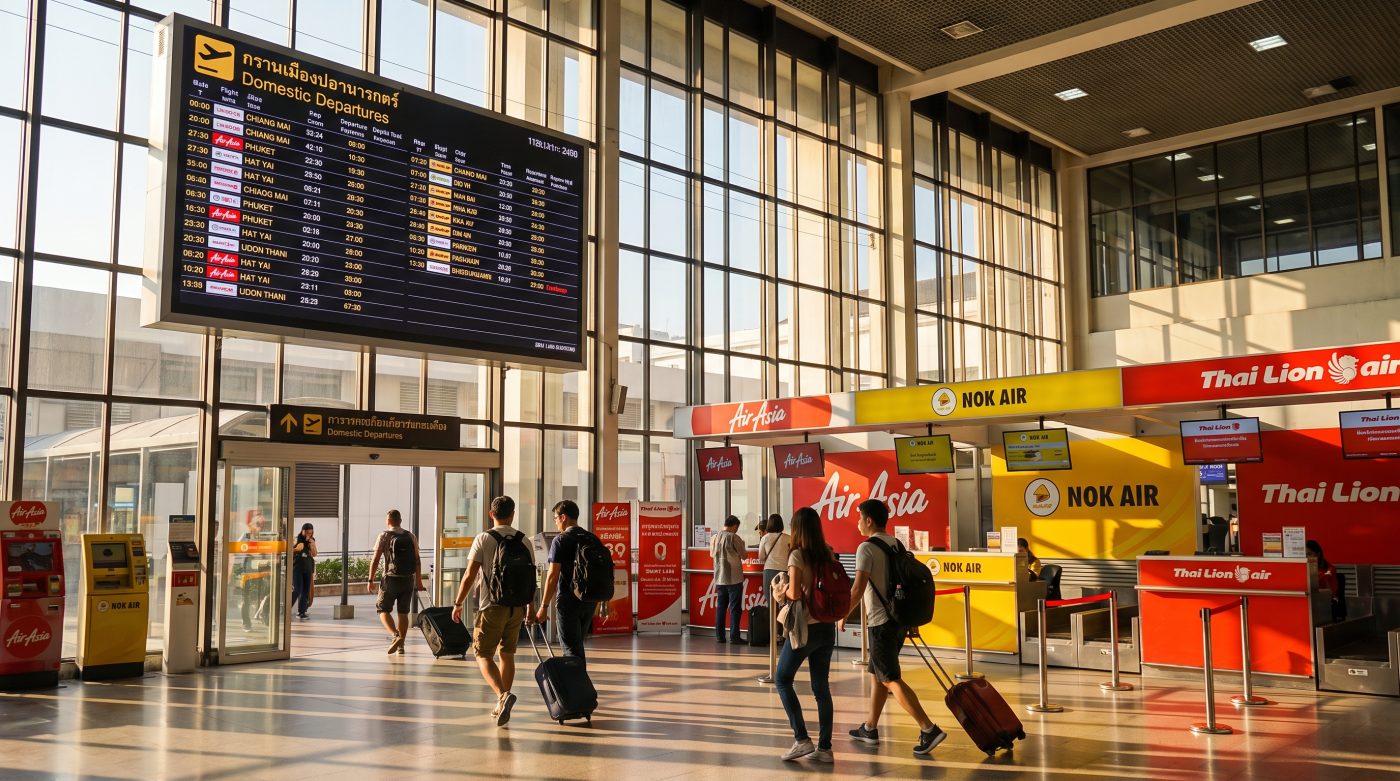
The six airlines flying domestic routes in Thailand
Thailand's domestic market splits cleanly into full-service and budget, and the split matters for more than comfort:
- Thai Airways — the national carrier, flies from Suvarnabhumi to around nine major cities (Chiang Mai, Chiang Rai, Phuket, Krabi, Hat Yai, Khon Kaen, Udon Thani, Ubon Ratchathani, Koh Samui). Checked baggage is included (20–30 kg depending on fare), and fares often run 1.5–2x budget prices — though booking about a month out can shrink that gap to roughly 10–20%.
- Bangkok Airways — the self-styled "boutique" carrier, also from Suvarnabhumi. It owns Samui Airport outright and runs the only direct flights to Koh Samui, plus free economy-class lounges in Bangkok, Chiang Mai, and Phuket. Good on-time reputation, but it's consistently the most expensive option on any route it serves.
- AirAsia — the largest low-cost carrier by route count, flying from Don Mueang to 20+ domestic airports. Cheapest during promo windows, but check-in tends to be slower and baggage/seat add-ons add up fast if you're not paying attention at booking.
- Nok Air — the widest domestic network of any Thai carrier (20+ destinations), and the one that bundles flight-plus-ferry tickets to Koh Samui, Koh Phangan, and Koh Tao in one booking. Long-time budget travelers on Thai expat forums have praised its pricing transparency and customer service for years, but current reporting also flags frequent delays — anywhere from 30 minutes to over 5 hours on some routes — so treat its reputation as mixed rather than settled, and check recent reviews before you fly.
- Thai Lion Air — flies to around 10 provinces from Don Mueang, with smaller schedules to less-visited airports. Its real edge is baggage: 10 kg checked free on most fares, which can make it cheaper all-in than a fare that looks lower before bags.
- Thai VietJet — the newest budget entrant, flying from Suvarnabhumi to around 10 destinations including Chiang Mai, Phuket, Krabi, and Surat Thani. Smallest route network of the budget carriers, but usually the cheapest checked-baggage add-on of the bunch.
Don Mueang vs. Suvarnabhumi: why the airport matters as much as the airline
Bangkok has two airports, and domestic carriers split almost entirely along full-service/budget lines: AirAsia, Nok Air, and Thai Lion Air fly out of Don Mueang (north of the city), while Thai Airways, Bangkok Airways, and Thai VietJet use Suvarnabhumi (the main international hub). A free shuttle bus connects the two for passengers with same-day or next-day onward tickets, but it's reported as taking anywhere from 45 to 75 minutes under normal traffic — and traffic can roughly double that. If you're connecting from an international flight into a domestic one, or doing a same-day multi-city hop, build in at least 4–5 hours for an inter-airport transfer rather than assuming it's a quick hop between terminals.
What domestic flights actually cost
These are current ballpark one-way fares — promos, season, and how far ahead you book all move them, so treat them as a starting point rather than a quote:
- Bangkok–Chiang Mai: around 1,200–1,400 THB budget, 3,000 THB full-service. Expect higher floors (3,000 THB+) during December–January peak season and the Feb–April burning-season haze months, when demand still holds up despite the air quality.
- Bangkok–Phuket: around 1,300 THB budget, 2,300 THB full-service, but over 2,200 THB even on budget carriers in the December–March high season. June–October is consistently the cheapest window, with promos sometimes under 1,200 THB.
- Bangkok–Krabi: often under 1,200 THB, rarely above 2,500 THB even at peak — one of the more reliably affordable domestic routes.
- Bangkok–Koh Samui (direct): Bangkok Airways essentially owns this route, and it shows — fares start around 1,800 THB but routinely exceed 6,000–10,000 THB in December. The workaround many budget travelers use: fly or bus to Surat Thani, then ferry across, for well under 2,500 THB on a promo fare, at the cost of several extra hours.
For how this fits into an overall trip budget, see our Thailand trip cost breakdown, and for how flight pricing shifts by season more broadly, see our month-by-month guide to the best time to visit.
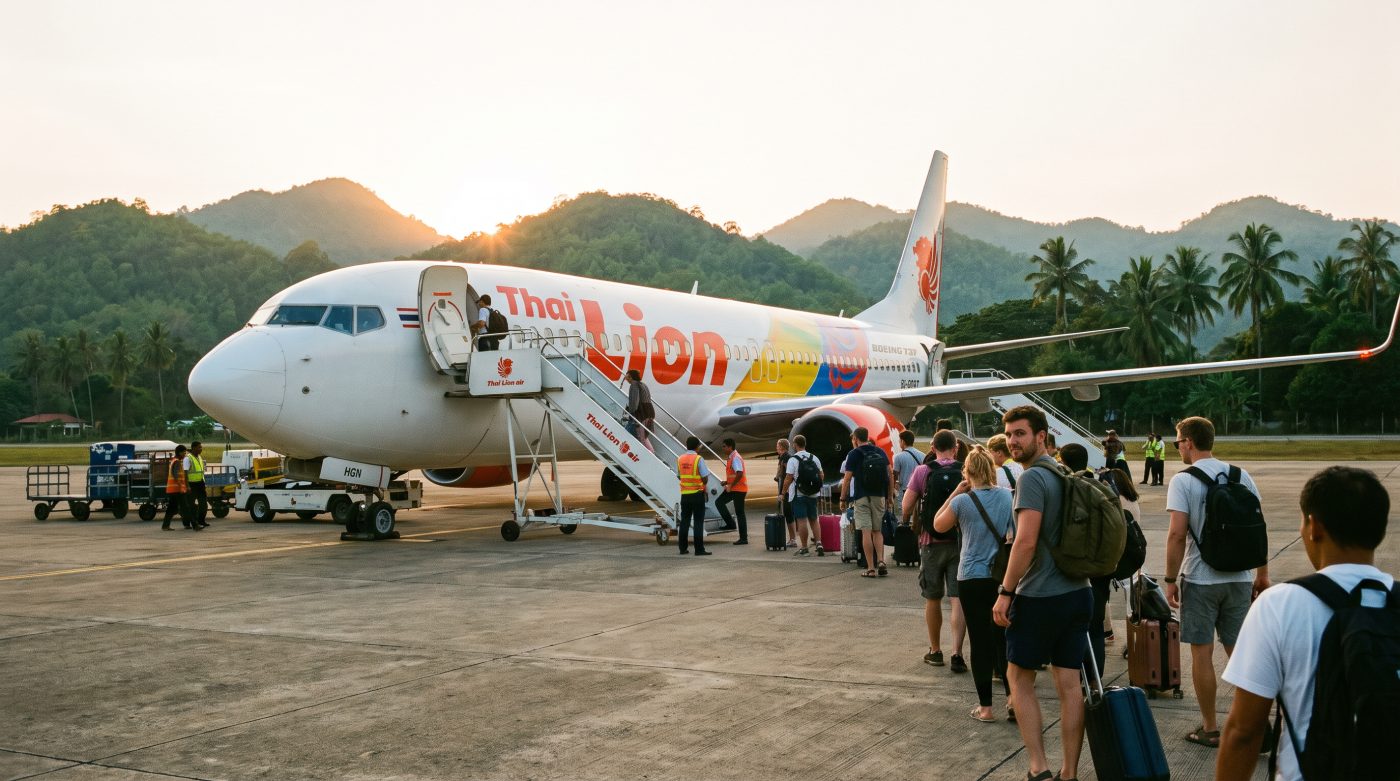
Baggage allowances and the fees that aren't in the headline price
This is where budget-carrier math gets misleading if you only compare ticket prices. Carry-on is a near-universal 7 kg across every airline, but checked baggage varies enormously:
- Thai Airways and Bangkok Airways include 20–30 kg in most fares.
- AirAsia charges from around 624 THB for 15 kg if you add it at booking (more if you add it later or at the airport).
- Nok Air charges from around 500 THB for the first 15–20 kg, plus more for additional weight, and adds a roughly 225 THB per-person processing fee on top.
- Thai Lion Air includes 10 kg checked free on most fares — often enough to make its all-in price competitive even when its headline fare isn't the lowest.
- Thai VietJet is usually the cheapest add-on among the budget carriers, from around 355–380 THB for 15 kg.
AirAsia, Nok Air, and VietJet also all charge separate per-person booking/processing fees (roughly 100–225 THB depending on the airline) that don't show up until checkout. If you're traveling with more than a carry-on, add these up before assuming the lowest sticker price is actually the cheapest ticket.
When and how to book for the best price
- Book weeks to a few months ahead for ordinary dates; for December–February travel, 2–4 months ahead is safer, and 3–6 months for the most popular routes and islands.
- Counterintuitively, the 7–21 day window before departure is often when prices spike rather than drop — last-minute domestic fares in Thailand are rarely a bargain.
- Midweek departures (Tuesday/Wednesday) are frequently cheaper than weekend flights; shifting your date by a day or two can save 30–50% on some routes.
- Book directly on the airline's own website rather than a third-party comparison site. Direct bookings are easier to change, refund, or get support on if your flight is disrupted — third-party bookings route you back through their support, not the airline's, when something goes wrong.
- Promo fares sell out fast and often land on inconvenient (very early or very late) flight times — worth it if your schedule is flexible, less so if it isn't.
What happens if your flight is delayed or cancelled
Thailand's Civil Aviation Authority (CAAT) tightened passenger-rights rules under Civil Aviation Board Regulation No. 101, in effect since May 2025 — and as recently as early October 2026, Thailand's Ministry of Transport publicly reminded airlines to honor these rules after a wave of Thai Airways delay complaints, so this isn't a rule that's quietly gone unenforced. For domestic flights specifically:
- Delay over 2 hours: free food/drinks (or vouchers) and free phone/internet access.
- Delay over 3 hours: the above, plus your choice of a refund, rebooking on the next available flight, or alternative transport.
- Delay over 5 hours: the above, plus 1,200 THB cash or an equal-value voucher if you agree to it.
- Cancellation: 1,500 THB cash or voucher, plus a refund, rebooking, or alternative transport — and if the replacement flight leaves more than a day later, the airline must also cover a night's accommodation and transport.
- Airlines are exempt if they gave at least 3 days' notice, found you a replacement arriving within 3 hours of your original arrival time, or the cancellation was from something beyond their control (severe weather, for instance).
You claim this at check-in or the gate first. If the airline doesn't pay, the formal route is filing a complaint directly with CAAT's Complaint Management System — which works, but means paperwork and follow-up on your own time while you're also trying to actually get somewhere.
For most domestic delays, claiming at the gate is simple enough to do yourself for free. But if an airline is stalling past these deadlines, disputing what you're owed, or your domestic delay has knocked out a connecting international flight too, AirHelp specializes in pursuing exactly these kinds of delay and cancellation claims on your behalf.
Check your flight delay compensation →
Flight vs. bus vs. train: when flying is actually worth it
On short hops, the math usually favors the bus or train once you factor in airport time — arrive 90–120 minutes early, plus getting to and from two airports instead of two downtown stations. But on longer routes, flying wins by a wide margin: Bangkok to Chiang Mai is roughly 70 minutes in the air versus 10–12 hours overnight by train or bus, and Bangkok to Phuket is about 90 minutes versus 12+ hours by road. For island routes without a direct flight (most of the Gulf islands), Nok Air and several budget carriers sell combined flight-plus-ferry tickets in one booking, which is usually both cheaper and less of a headache than booking each leg separately — see our island-hopping guide for how those ferry connections work on the ground.
▶Watch on VacaHack
Quick answers
Which domestic airline is cheapest in Thailand?
AirAsia and Nok Air usually have the lowest headline fares, especially during promo windows, but Thai Lion Air's free 10 kg checked bag and VietJet's cheap baggage add-ons can make either one cheaper all-in once you factor in a checked bag. Compare the total price including baggage and processing fees, not just the fare shown first.
Is it cheaper to fly or take the bus or train in Thailand?
On short routes, buses and trains are often cheaper once you include airport time. On longer routes like Bangkok to Chiang Mai or Phuket, flying is usually worth the extra cost in time saved — a 70–90 minute flight replaces a 10–12+ hour overnight bus or train.
Do domestic flights in Thailand include checked baggage?
Thai Airways and Bangkok Airways include 20–30 kg. Budget carriers vary: Thai Lion Air includes 10 kg free on most fares, while AirAsia, Nok Air, and VietJet all charge extra for checked baggage, usually starting around 350–625 THB for 15 kg if added at booking.
What happens if my domestic flight in Thailand is delayed or cancelled?
Under CAAT's Regulation No. 101 (in effect since May 2025), delays over 5 hours entitle you to 1,200 THB cash or voucher on top of meals and rebooking options, and cancellations entitle you to 1,500 THB plus a refund or rebooking. Claim it at check-in or the gate first; if the airline won't pay, you can file a formal complaint with CAAT.
Which Bangkok airport do domestic flights use?
It depends on the airline. AirAsia, Nok Air, and Thai Lion Air fly from Don Mueang. Thai Airways, Bangkok Airways, and Thai VietJet fly from Suvarnabhumi. A free shuttle connects the two airports but can take 45–75+ minutes, so allow 4–5 hours if you're connecting between them.
How far ahead should I book a domestic flight in Thailand?
A few weeks to a couple of months ahead for most dates, and 2–4 months ahead (3–6 for peak season or island routes) for December–February travel. Oddly, the 7–21 day window before departure is often when prices spike rather than drop, so last-minute bookings are rarely a bargain.