Dengue Fever and Mosquito-Borne Illness in Thailand: Real Risk, Real Precautions
Yes, dengue fever is a real and ongoing risk in Thailand, not a rare scare story: the country typically reports tens of thousands of cases a year, with transmission heaviest during the June-to-October rainy season. Most travelers who take basic precautions never get it, but it is common enough that every visitor should know the actual symptoms, know when a fever means "go to a hospital" instead of "wait it out," and understand it is not the only mosquito-borne illness worth knowing about.
How common is dengue in Thailand, really?
Dengue is endemic across Thailand — there is no region that is fully risk-free — and case counts swing a lot year to year depending on rainfall and mosquito control efforts. Thailand's public health authorities recorded roughly 51,800 dengue cases and about 120 deaths in the twelve months leading into late 2025. That is a moderate year by recent standards: the country logged around 46,755 cases in 2022, then a much sharper 136,655 cases in 2023. Because the numbers move this much year to year, treat any specific figure here as a snapshot rather than a fixed rate, and check Thailand's Ministry of Public Health or the WHO's Thailand country page for the current season's count before a trip if you want the latest number.
When and where the risk is highest
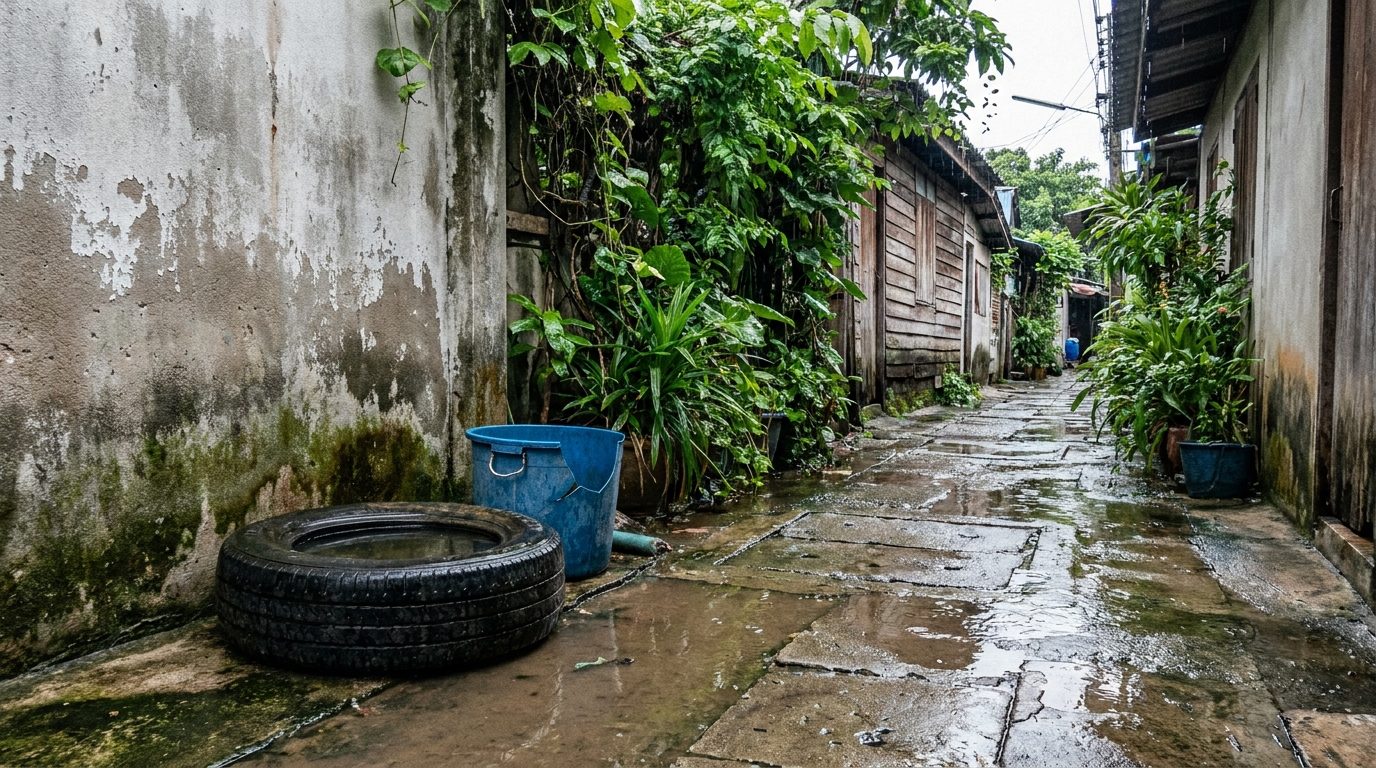
Peak transmission runs roughly May through September, tracking the rainy season, when standing water after rain gives Aedes mosquitoes places to breed. Southern provinces, the islands during wet season, and northern provinces around the monsoon months tend to see higher case counts, but dense urban areas including Bangkok also report cases year-round — Aedes mosquitoes breed in small urban containers (buckets, plant saucers, old tires, blocked gutters) and don't need a jungle to thrive. One detail that surprises a lot of travelers: dengue-carrying mosquitoes bite mostly during the day, especially early morning and late afternoon, not just at dusk — so "I'm only worried about mosquitoes at night" is a genuinely common and genuinely wrong assumption.
Symptoms: what dengue actually feels like
Symptoms typically show up 3 to 14 days after an infected mosquito bite. Classic dengue looks like a sudden high fever (39-40°C / 102-104°F), a severe headache often with pain behind the eyes, intense muscle and joint aches (the old nickname "breakbone fever" is not an exaggeration), a skin rash, nausea, and heavy fatigue that can last several days after the fever itself breaks. Most cases resolve with rest, fluids, and time — but a meaningful minority progress to something more serious, which is the next section.
Warning signs that mean go to a hospital, not wait it out
The dangerous phase of dengue, when it happens, tends to arrive 3 to 7 days after the fever starts — often right as the fever itself seems to be breaking, which is exactly when people are tempted to relax. Get to a hospital rather than riding it out at a guesthouse if you or a travel companion develop any of these: severe or persistent abdominal pain, vomiting that won't stop, bleeding gums or nosebleeds, blood in vomit or stool, unusually rapid breathing, extreme restlessness or confusion, or a fever that suddenly drops while the person feels worse rather than better. These are the recognized warning signs of severe dengue (sometimes called dengue hemorrhagic fever), and in Thailand's private hospitals this is a well-understood, well-treated emergency — the risk is in not getting seen quickly, not in Thai healthcare being unequipped for it.
What treatment actually looks like, and what it costs
There is no antiviral cure for dengue — treatment is supportive: rest, oral rehydration or IV fluids, and fever/pain control with paracetamol. This is a genuinely important detail to get right: avoid aspirin and other NSAIDs (ibuprofen, naproxen) for a dengue fever, since they increase bleeding risk. Mild cases are managed with rest and monitoring at home or a clinic. More serious cases mean hospital admission for IV fluids and platelet monitoring until the critical phase passes.
On cost: a commonly cited real-world figure for a dengue hospital admission in Thailand is an average of around $1,200 USD for a 3-day stay, with a typical range of roughly $650 to $2,500 USD depending on the hospital and severity — treat this as a ballpark, not a quote, since it varies by facility and case. As with other unplanned hospital visits in Thailand, private hospitals commonly ask for a payment guarantee or deposit before admitting a patient without confirmed insurance on file, which is the exact scenario travel medical insurance exists to solve. If you don't already have a policy in place, it's worth sorting out before you need it, not after.
Dengue is one of the more common reasons a Thailand trip turns into an unplanned hospital bill. SafetyWing's Nomad Insurance covers hospital treatment abroad and is built for exactly this kind of unplanned cost.
Check SafetyWing Nomad Insurance →
Prevention that actually works
- Use a repellent with 20-50% DEET or picaridin, and reapply it — sweat and swimming wash it off faster than the label suggests.
- Wear long, light-colored sleeves and pants during the day, not just at dusk, since Aedes mosquitoes bite mainly in daylight hours.
- Stay in rooms with air conditioning or intact window screens; a mosquito net is worth packing for guesthouses or bungalows without either.
- Empty or cover anything that can collect standing water near where you're staying — buckets, plant saucers, bottle caps, and old tires are the actual breeding grounds, not swamps.
- Mosquito coils and plug-in repellents help indoors overnight, especially in older buildings without tight screens.

Other mosquito-borne illnesses worth knowing about
Dengue gets the most attention, but it's not the only one:
- Chikungunya — causes a similar fever, but the joint pain is often more severe and can linger for weeks. As of this writing, the CDC lists Thailand among countries with "elevated background risk" for chikungunya rather than an active outbreak, and generally only recommends the newer chikungunya vaccine for travelers planning extended stays of six months or more, or for travel to an area with a currently declared outbreak (Thailand isn't one right now). Alert levels shift, so check the CDC's current Thailand travel health notice close to your trip rather than relying on this paragraph.
- Japanese encephalitis — rarer but more serious, mainly a risk for longer stays or rural/rice-farming areas. We cover who actually needs this vaccine in our Thailand travel vaccines guide.
- Zika — low current concern for most travelers, but pregnant travelers or those trying to conceive should talk to a doctor before a Thailand trip regardless of the current risk level, since Zika's main danger is to a developing fetus.
Is there a dengue vaccine? Should you get one?
Yes, one exists: a two-dose dengue vaccine (branded Qdenga in much of Asia) is approved for ages 4-60 and shows around 80% efficacy against symptomatic dengue across the main virus strains in trials, with a bigger reduction in hospitalization risk. It's available at private hospitals in Thailand, generally in the low thousands of baht for the two-shot series given three months apart. That said, it isn't a blanket recommendation for a short tourist trip the way, say, a tetanus booster might be — eligibility and prior-exposure considerations vary (some dengue vaccines are only appropriate for people who've already had a prior dengue infection), so this is a conversation for a travel clinic doctor a few months out from your trip, not a same-week decision.
None of this means you should spend your trip afraid of mosquitoes — most visitors to Thailand never get dengue. It means the basics (repellent, covering up during the day, screens at night) are worth the minor hassle, and that if a high fever with severe body aches shows up during or shortly after a Thailand trip, it's worth getting checked rather than assuming it's just a cold.
Quick answers
How common is dengue fever in Thailand?
It's endemic nationwide and case counts vary a lot year to year with rainfall — roughly 51,800 cases and about 120 deaths were reported in the twelve months leading into late 2025, versus 46,755 cases in 2022 and 136,655 in 2023. Check Thailand's Ministry of Public Health for the current season's count before a trip.
What are the first symptoms of dengue fever?
A sudden high fever (39-40°C), severe headache with pain behind the eyes, intense muscle and joint pain, a skin rash, nausea, and heavy fatigue, usually starting 3 to 14 days after the mosquito bite.
When should I go to the hospital for dengue in Thailand?
Go immediately if you develop severe abdominal pain, vomiting that won't stop, bleeding gums or nosebleeds, blood in vomit or stool, rapid breathing, confusion, or a fever that suddenly drops while you feel worse rather than better — these are warning signs of severe dengue, most likely 3 to 7 days after the fever starts.
What time of day are dengue-carrying mosquitoes most active?
Mostly during the day, especially early morning and late afternoon — not just at dusk or night, which is a common misconception. Daytime repellent and coverage matter as much as evening precautions.
Is there a vaccine for dengue fever?
Yes — a two-dose vaccine (branded Qdenga in much of Asia) is approved for ages 4-60 and available at private hospitals in Thailand, but eligibility depends on factors like prior dengue exposure, so it's a conversation for a travel clinic doctor rather than a blanket recommendation for every short trip.
How much does dengue treatment cost in Thailand?
A commonly cited ballpark for a 3-day hospital admission is around $1,200 USD on average, with a typical range of about $650 to $2,500 USD depending on the hospital and severity — treat this as an estimate, not a quote.